At that moment I found Bitcoin and what Bitcoin did for me is like being that point of light in that dark cave.
One humid morning in 2020, Rajarshi Maitra walked into his manager's office and told his manager he needed to go to the hospital.
There was no hospital.
The reason for the lie was that Raj didn't want to serve the notice period. He knew what this meant — in civil engineering, HR departments gossip with each other, and walking out without a notice follows your name for years. He'd spent six years building that professional reputation. Then he burned that bridge with a punk rock shrug.
I knew I was going to get blacklisted. But I was very sure, like, I don't give a f---. F--- you, I have served you enough. I have served you for six years. I deserve to just quit now.
Five days later, Spiral offered him a grant. One of the best open source grants in the Bitcoin ecosystem, and he hadn't applied for it.
He sat alone in his room for half an hour after the call. He couldn't tell the news to anyone because nobody in his family or friends knew what he was going through. Some knew about the resignation and the ongoing divorce, but no one knew about Bitcoin and what this moment meant.
"The impact of that moment was so big for me that a celebration couldn't justify it. It has to be just like me sitting there in humble silence and thanking God or Satoshi or whatever," Raj says.
He'd been an atheist his whole life, growing up in an orthodox Hindu family and never subscribing to any of it. "I think Satoshi as a god is real," he laughs. After that moment, he started believing in something beyond himself.
Three years later, that belief grew into Bitshala — India's main Bitcoin developer education organization, and the project OpenSats would come to fund.
Before any of that, in his apartment in Kolkata, engineering drawings covered Raj's desk: stress calculations for a building in West Bengal that would carry load for decades, indistinguishable from the hundred before it except by a reference number.
"You can maybe play around with the shape of it," he says, "but the mechanics of structure, nothing new there. Everything has been scoured up."
So after work he'd turned to theoretical physics, quantum mechanics, cosmology, and the hardest mathematics he could find. "My Netflix and chill after the office hours," he laughs.
For two and a half years, physics gave his mind something to play with. Then he'd studied himself all the way to the outer edges of it, to the point where the next step requires entering academia. He'd been inside it enough to know what that would entail.
"It's just another mode of the same energy," he says: the same menial daily grind, just like the current job, though this time up in the ivory tower. He'd rather study his physics for fun.
For a while, Raj carried on, but the gnawing feeling inside of him grew. He still showed up: drawings at the desk, meetings, paychecks every month. He numbed himself, hoping that if he didn't see it, name it, and give it weight, then maybe the feeling would subside. His days rolled one into the next, each the same.
"I can just wake up, be a robot, go to my job, keep everything perfect, get my salaries in and not think about anything," he says.
In the end, it didn't hold. His marriage was falling apart. "I went too far," he says, without elaborating.
By mid-2016 he'd hit the bottom of the abyss. He describes what followed as a dark cave: no source of light anywhere, no point visible to walk toward. He could only sit there.
"I'm just sad all the time. Your soul is asking for something that you are not giving, and none of the answers you can see around you are satisfying."
I was obsessed. I was learning about the economic facts of Bitcoin, the technical facts of Bitcoin and the social facts of Bitcoin, all at the same time.
It was one of Andreas Antonopoulos' videos that explained Bitcoin as a 'digital anarchic system.' Those three words echoed in Raj's mind, and he knew there was something there, but he couldn't quite see it yet.
"I just needed these three words to figure out and connect the dots," he says. "I'm not even looking for a job. I'm not even looking for a career. I'm looking for a hook to get into."
The dots, as he puts it, were politics, Austrian economics, and computer science.
Politics came first: university years spent at a campus that was the epicenter of West Bengal's 1970 communist revolution, a politics he believed blindly. Then he left campus, watched that belief collide with how the world actually worked, and went looking for an explanation.
Austrian economics gave him one: a body of theory built on why centrally planned systems always fail. Then mathematics and computers, two and a half years of self-teaching layered on top of everything else.
His initial response had been skepticism: this cannot be true... this is too good to be true... maybe these guys are lying on the internet for views... or maybe like it's half-baked truth?
What changed things was finally understanding why Bitcoin's mining process can't be stopped: a network, once decentralized enough, becomes something no state or cartel can switch off.
"And if it cannot be killed and if it's decentralized enough, then you can do anarchy politics on top of that," he says. "That was my aha moment."
He jumped in during a conflict that he didn't know was going on, the blocksize war.
With engineering drawings on his desk and Twitter open beside them, he'd been following the conflict for months: learning the economics, the protocol and the social dynamics all at once, barely keeping pace with the terminology.
By mid-2017 his boss was calling: Why Raj, what's happening? You are not paying attention to your designs?
He watched the mining cartel hold out, month after month, then waver. SegWit, the upgrade they had tried to block, activated that August. A hard core of them forked away to start their own chain, Bitcoin Cash. Then came the cartel's last move, a plan they called SegWit2x: hatched in a New York hotel, backed by most of the world's mining power and a roomful of companies, set to double Bitcoin's block size that November.
Thousands of node operators refused to run it. It collapsed before it ever activated. Each had made the same choice in private, and the sum of those choices had held the line.
"By that time I was totally sold. I cannot unsee what I just saw."
In Kolkata there is a market, Gariahat, one of the densest in the city, and sometimes Raj goes there just to stand in the crowd. He likes to absorb the thousands of people navigating the same square meters with neither traffic lights nor authority directing traffic, and everyone moving through the crush on intuition alone.
"If you look from a drone on top," he says, "it's like ants, self-arranging. It's absolutely chaotic but everybody knows where to go next. They are always communicating with each other in some form of way, otherwise you cannot get around."
It's also how Bitcoin works: every node makes its own choice, where no authority coordinates the result, and the system arrives at consensus without anyone planning it.
Bitcoin education has to work the same way, Raj opines: loose enough for each person to find their own way through, with no fixed curriculum routing everyone down the same path.
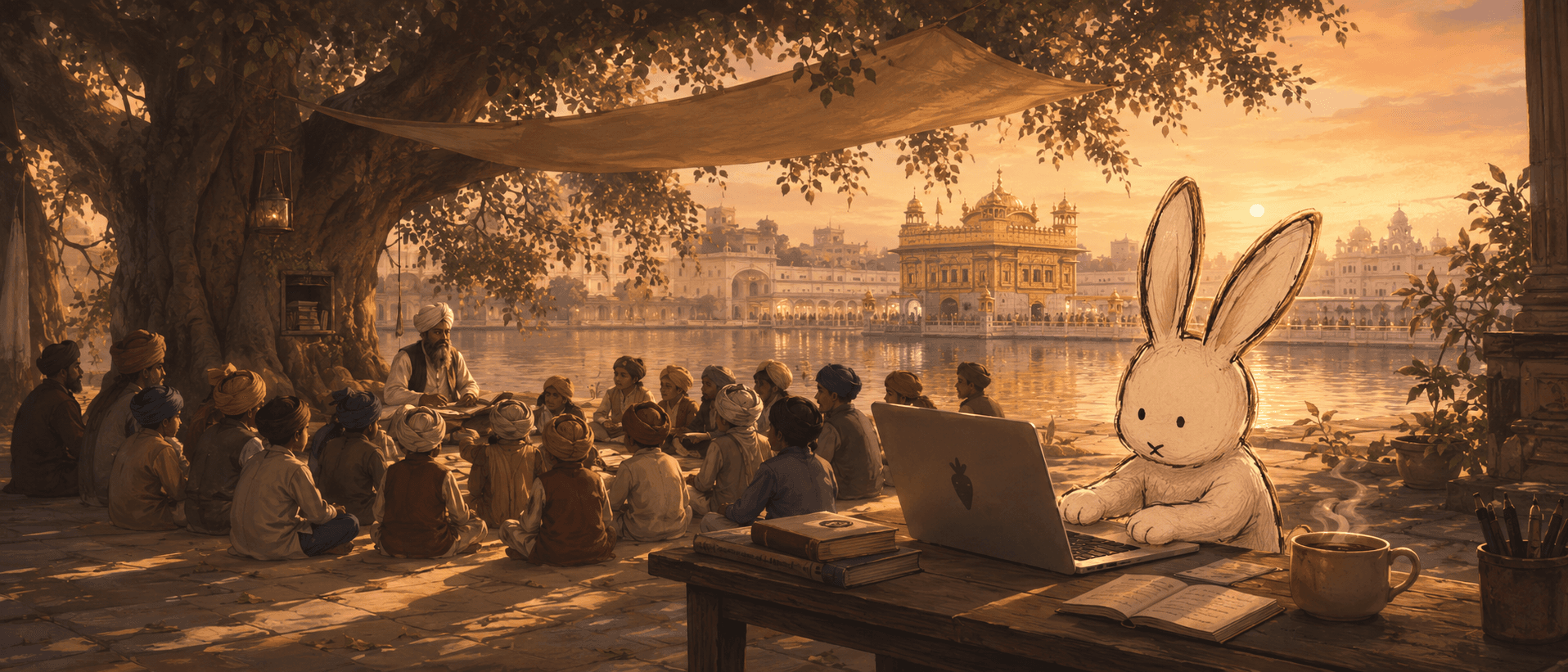
India once had a name for that: Pathshala.
They would go under a big banyan tree or any other kind of big enough tree. They will put seats around it and the teacher will stand there, use the tree trunk as his board, and the students will sit around it. And there will be a bunch of trees like that. That's it. That's the school.
For thousands of years before universities arrived in India, learning happened wherever a teacher chose to sit: under banyan trees, in temple courtyards, in village clearings open to the air, without buildings or examinations or certificates, just a teacher worth finding and students who had heard of them.
The last Pathshalas closed in the 1960s, displaced by universities with their fixed curricula and their credentials. His father had attended one of the last ones in West Bengal.
He wanted to do the same thing for Bitcoin. Bitcoin pathshala. Bitshala.
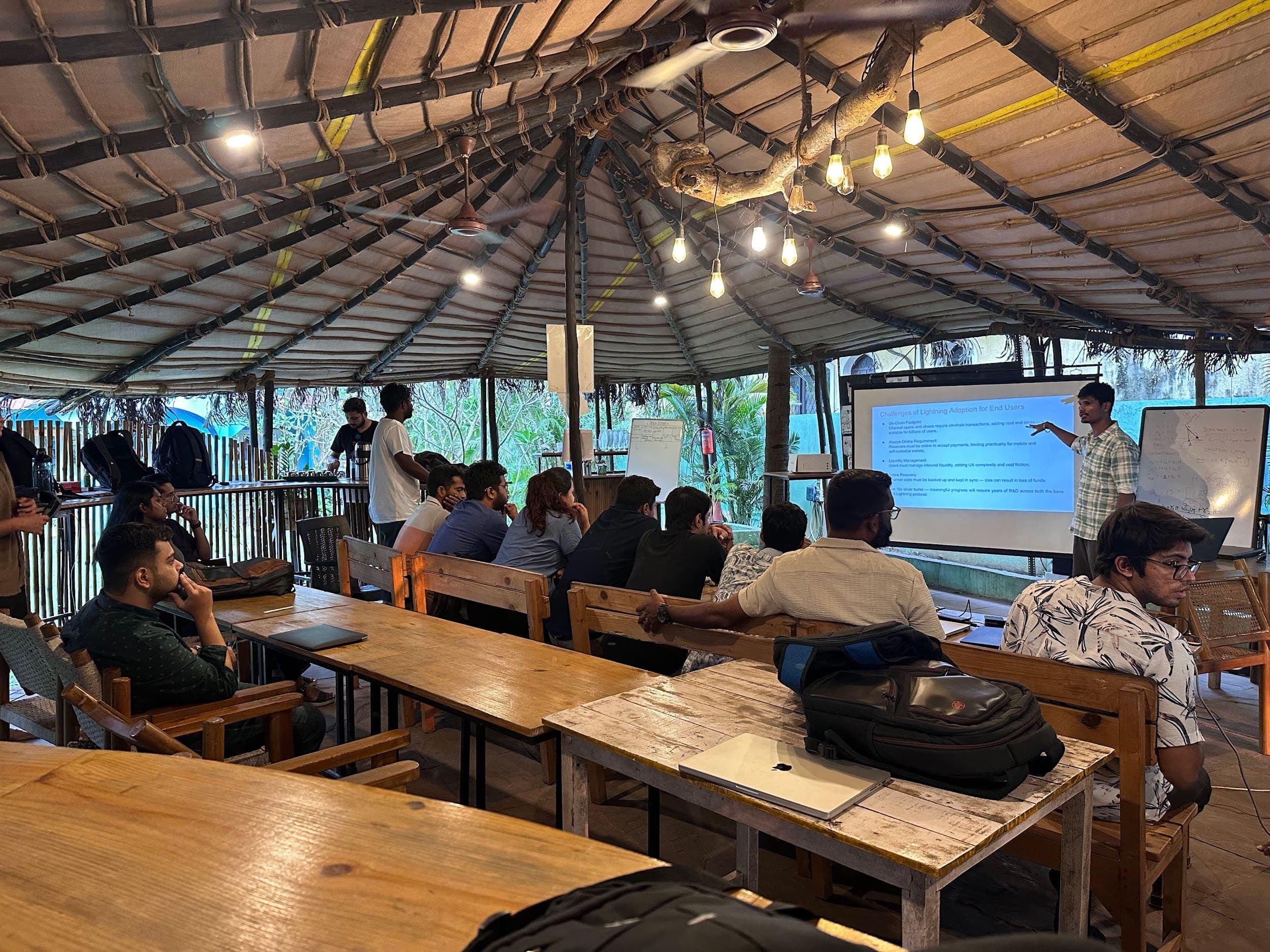
What Bitshala does is figure out how to reduce that three years [of his bitcoin journey] into six months.
By now Raj had years of experience in open-source development and Bitcoin, and enough distance from his own cave to want the same way out for others. "Nobody asked for my degree. Nobody asked if I had a coding background or not. I was just a random person in GitHub who was solving their test issues and they were happy with it. And that felt liberating as a job to do," Raj says.
But engineers and students from his community kept finding him, all arriving at the same impasse: where to begin?
For three years, his answer to anyone who asked was a document he kept quietly updating: bookmarks, books, projects, and communities woven into something like a map. He shared it freely, passing it along to anyone who needed a place to start. Over time it grew daily dense enough that he began to see it differently. It wasn't a list anymore; it was a course.
He launched Bitshala in January 2023. Three years on, close to 1,500 people have completed at least one cohort across ten Indian cities, and ten of them now work full-time on Bitcoin, paid through grants from OpenSats Developer Training, HRF, Spiral, and BTrust.
Bitshala is one of several such programs that OpenSats backs around the world, from Brazil to Amsterdam to university classrooms everywhere, each one shaped by where it grows.
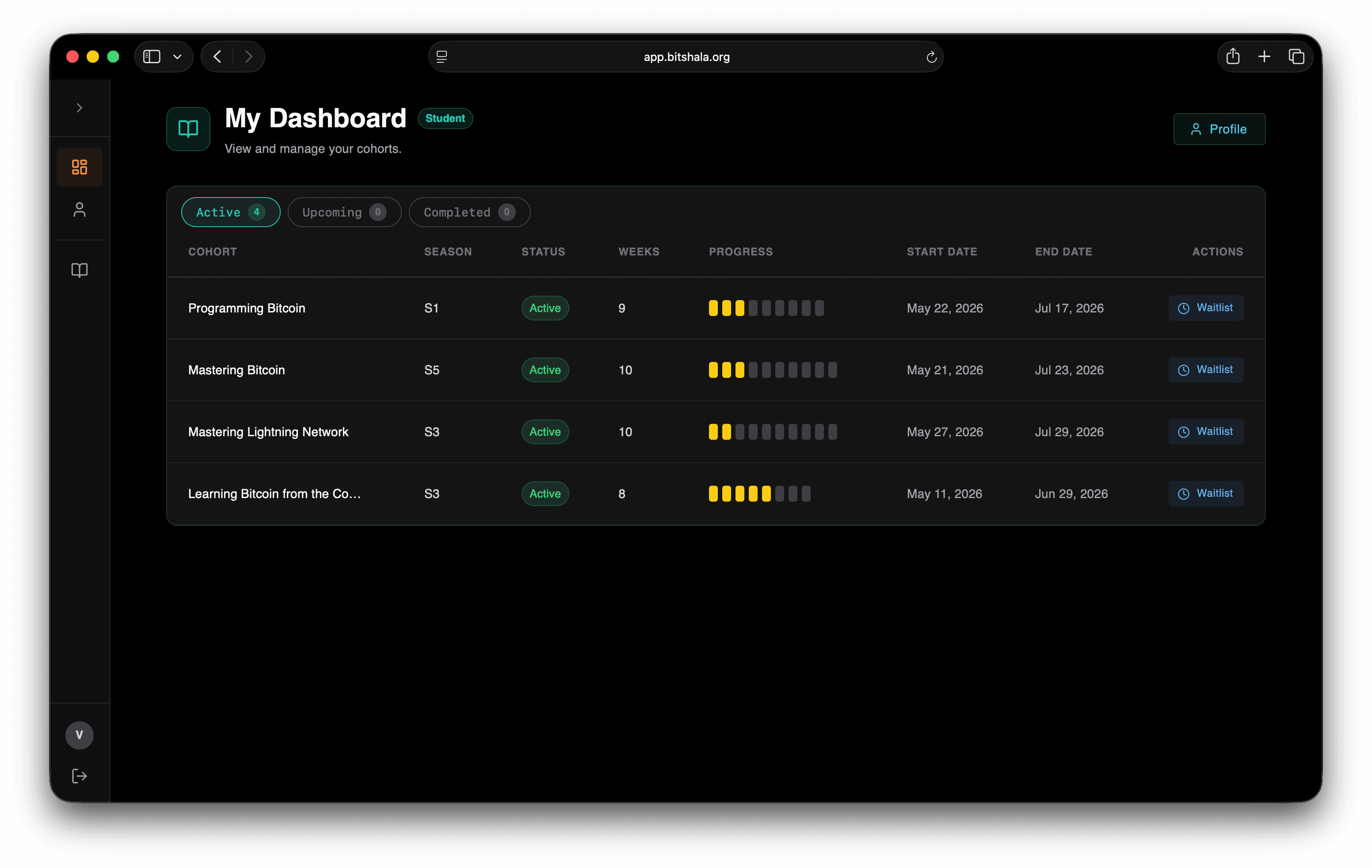
In practice, five cohorts now run back to back, based on the following books: Mastering Bitcoin, Learning Bitcoin from the Command Line, Programming Bitcoin, Bitcoin Protocol Development, Mastering the Lightning Network. It takes under a year altogether, free, on Discord.
There's a certificate at the end, but nobody frames it; what graduates carry with them is proof of work.
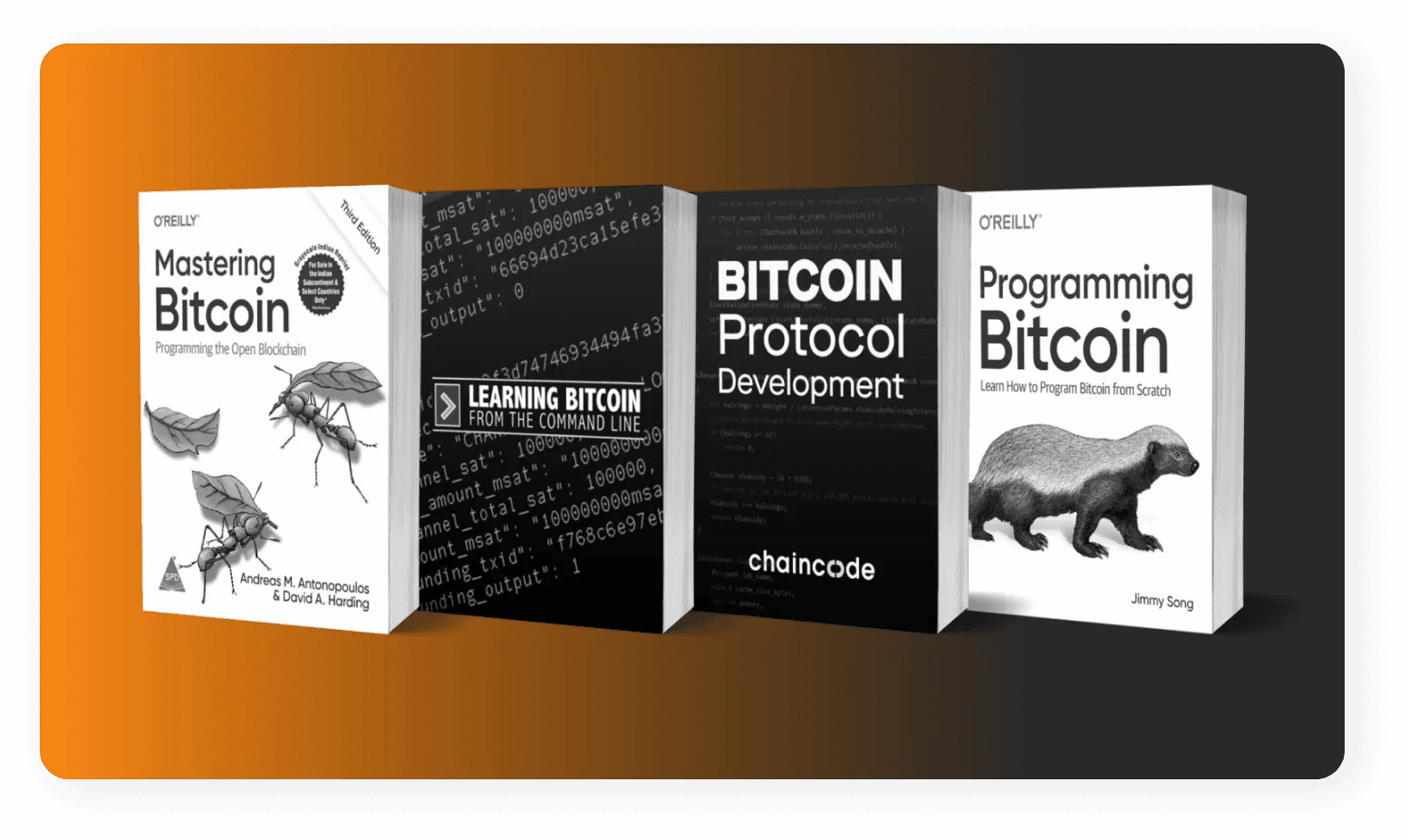
Most people follow roughly the same path through the five books, theory first and the harder material later, though nothing is enforced. Cohorts meet live, every week, online, with no recordings to fall back on.
The proof of work that matters is a real GitHub issue on a real Bitcoin or Lightning project, fixed well enough that a maintainer is willing to vouch for it. It's the same kind of issue Raj once solved himself, with no credentials and nobody asking for any.
One of the highlights of Bitshala culminated in March 2025, when thirty-three developers gathered at a beach resort in Colva, South Goa. Mornings ran on privacy protocols, second-layer scaling, and cryptographic tooling; evenings went wherever the conversation wanted to go.
Nothing like it had happened among Indian Bitcoin developers before. "Everybody is so unique, everybody is so passionate and interested," Raj says. "The best thing I loved about it is the people I found along the way. They say maybe the real Bitcoin is the friends you make along the way."
Raj married again. His wife tells him he never stops working, and he doesn't disagree. Making himself work isn't the problem; making himself stop is.
"I'm making an impact into the world that I want to see myself, want to leave myself, I want my kids to inherit," he says. "The world doesn't exist yet, but I'm like a brick layer of that world."
His official title is General Lead, and occasionally CEO, but he prefers the lead janitor without the capital letters. After all, "you clean up the mess, you're always cleaning up the mess, that's the job."
Figure out what you are good at, do it for Bitcoin and Bitcoin will figure it out for you. And it's an absolute 100% sure-shot guaranteed formula to work. I have not seen that fail. Look at me! It's absolutely fu---ng magic.
Raj sat cross-legged in his chair, legs folded under him, his body angled slightly away, in a dim hotel café in Oslo at the end of a long day at a human rights conference. I asked what he would tell a person still in the darkness, before Bitcoin, before any point of light at all.
The first thing, he said, is to name it as a crisis. Most people don't. They negotiate with the pain, tell themselves the dissatisfaction is their fault, and try to make it okay. But the signal is real. Recognize it, and you've already solved the hardest part.
Then comes the waiting. There's no forcing an answer you can't yet see. He knew this from inside his own cave years: the impatience nearly broke him more than the darkness ever did. When can I solve this, when can I solve this, the cave walls echoed. Time turned out to be the mechanism, not proof of work. Time.
One day a point of light shall appear. Most people see it and decide it's too far to be worth trying. Walk toward it anyway, he said.
You overestimate the distance, way more than it actually is. "Once you start walking towards it, the light also comes closer towards you, and the last mile you can just run."
Raj has been an OpenSats grantee since January 2025, with his grant renewed in March 2026. "When we first applied," Raj says, "the only other support fund we had was a private donation, one-time, that had run out. And if OpenSats said no, I wouldn’t have known where to go."
If you want to support Raj, join Bitshala — as a student, a contributor, or a teacher. Our support for Raj's work was made possible thanks to your generous donations to The General Fund. For comments, corrections, or suggestions about our Spotlight series, please reach out to spotlight@opensats.org.